Explore the exquisite wood selection in our workshop, where only the finest materials are chosen to create exceptional flutes. Each piece of wood is carefully inspected and selected for its unique characteristics and acoustic properties.
Olive Wood

Olive wood delivers a rich, full, and highly balanced sound quality. Because olive wood is exceptionally dense and heavy, its acoustic properties closely resemble elite, high-end tropical tonewoods like Macassar Ebony or African Blackwood.
Acoustic Profile & Tonality:
Instruments built from olive wood typically yield distinct sound characteristics:
Rich Overtone Complexity: The naturally wavy, interlocked, and irregular grain structure of the wood lends a deep complexity and a moderate level of overtones to the sound profile.
Crisp High-End: It provides a clear, snappy, and bright response on the treble frequencies.
Excellent Projection: Thanks to its high Janka hardness (measuring around 2,700 lbf), it offers powerful sound projection and robust volume.
Light and Airy Variants: Depending on the instrument type and specific wood species, it can also produce a distinctly light, clear, and open acoustic tone.

Sugar Maple Wood
Maple wood is highly regarded for its bright, clear, and sonically "transparent" sound quality. Because it is a dense hardwood, it offers a quick note decay and high internal dampening. This allows the true acoustic character of the instrument's top wood or the player's natural technique to shine through without excessive overtone coloration.
Acoustic Profile & Tonality:
Bright and Punchy: Maple delivers strong high-end response and projection. It sounds much brighter and sharper than warmer woods like mahogany.
High Note Separation: Unlike, say, rosewood, which amplifies vibration and emphasizes overtones, maple offers a high level of internal dampening. This results in very quick note decay, and enhances note separation and clarity.
Sonic Transparency: It acts like a flat EQ. Maple is used in acoustic guitars because of its sonically “transparent” qualities, which let the tonal character of the top ring through without significant tone coloration from the back and sides.
Excellent Feedback Resistance: Because it focuses on the fundamental note rather than ringing out with complex, muddy overtones, maple instruments are excellent for live performances on loud stages.
Cocobolo wood is highly regarded for its fast response, powerful projection, and striking tonal clarity. As a true rosewood (Dalbergia retusa), its extreme density and high oil content give it a unique acoustic profile. Builders and players often describe it as a bridge between the deep, rich overtones of Brazilian Rosewood and the bright, shimmering treble response of Koa.
Acoustic Profile & Tonality:
Powerful Projection: Because cocobolo is incredibly heavy and dense, it forces energy into the instrument's soundboard.
Articulate Trebles & Glassy Attack: It offers a distinctive bright overall tone emphasized by sparkling treble notes.
Tight, Pronounced Low End: While it features a deep bass response, it is generally tighter and less boomy than East Indian Rosewood, ensuring individual notes remain distinct.

Cocobolo Wood
Black Ebony wood is highly regarded in the musical instrument world for its bright, crisp attack, strong projection, and excellent note articulation. It is an incredibly dense, heavy, and hard tonewood. This structural profile gives it a fast "transient response"—meaning notes pop out instantly with clear separation rather than blending together.
Because true black ebony (such as Gabon or African Ebony) is rare and heavy, its impact on sound quality depends entirely on how an instrument uses it.
Acoustic Profile & Tonality:
Bright & Punchy: It adds a noticeable "snap" or "ping" to the high-end treble frequencies. It provides "Brightness, attack, bite paired with a slick, speedy feel."
Exceptional Sustain: Due to its immense hardness, it minimizes string energy loss, giving fretted and fretless notes a long, smooth decay.
Perceived vs. Real Impact: While guitarists notice a brighter response compared to warm, porous woods like rosewood, the tonal impact of a fretboard is highly prominent on acoustic and classical instruments, but more subtle on solid-body electric guitars.
High-density black ebony provides a dark, focused, and powerful fundamental woodwind tone with great projection.
Black Ebony Wood
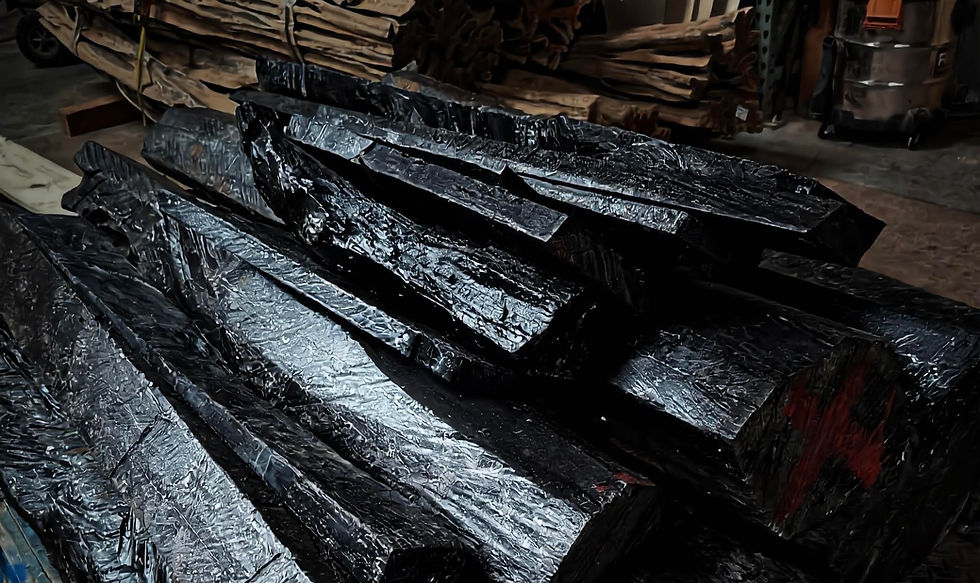
Nicaraguan/Panama Rosewood
Nicaraguan (Yucatan/Panama) rosewood possesses a highly refined, rich, and responsive sound quality that closely mirrors the prestigious "gold standard" of Brazilian rosewood. Depending on the specific species sold under this common name, it delivers either a pristine, bell-like clarity or a high-fidelity warmth with incredible sustain.
Acoustic Profile & Tonality:
When luthiers refer to Nicaraguan rosewood as a direct tonal successor to Brazilian rosewood, It yields a highly refined, articulate, and understated resonance. It retains the signature rosewood traits—deep lows and sparkly highs—but with a smooth, mature, and complex harmonic depth that isn't overly harsh or bright.
Liveness: It has excellent tap-tone resonance, vibrating freely to give high-end acoustic guitars an open, airy, and premium projection.
Mahogany is celebrated as a warm, woody, and midrange-focused tonewood that delivers incredible note clarity and a fast, punchy acoustic response. Unlike the dense "hi-fi" resonance of rosewoods, mahogany emphasizes a dry and direct fundamental tone, meaning the exact note you pluck is front and center without being washed out by metallic overtones.
Acoustic Profile & Tonality:
The "Midrange Meat": While most acoustic guitars naturally push frequencies outward, mahogany concentrates heavily on the lower-mid and upper-mid ranges. This gives the instrument a dark, sweet, and meaty core.
Dry, Woody Textures: Musicians frequently call mahogany "dry" because it produces clean note separation with a low overtone profile. Strings decay precisely rather than bleeding continuously into a cloud of internal reverb.
Fast Attack: It has a highly reactive, cannon-like velocity. When you strike a string, the sound projects forward immediately, offering distinct definition during lightning-fast flatpicking runs.
Mahogany Wood
North Indian Rosewood (Dalbergia sissoo) produces a highly resonant, warm, and clear sound profile that heavily mirrors its famous southern cousin, East Indian Rosewood (Dalbergia latifolia). Often harvested across northern India and Pakistan, it has an excellent strength-to-weight ratio and a dense composition that gives it a beautiful acoustic response.
Acoustic Profile & Tonality:
Deep, "Throaty" Lows: It provides a strong, robust bass presence. The low end is powerful and room-filling, but it maintains enough tightness to avoid getting muddy during heavy flatpicking.
Bell-Like Trebles: The high frequencies ring out with a glassy, metallic shimmer. Treble notes are highly articulate, giving individual strings excellent definition within complex chords.
Naturally Scooped Midrange: Like most true rosewoods, it pulls back slightly in the middle frequencies. This "mid-range scoop" creates a perfect sonic pocket that allows a human vocal range to sit perfectly over the music without competing.
North Indian Rosewood


